

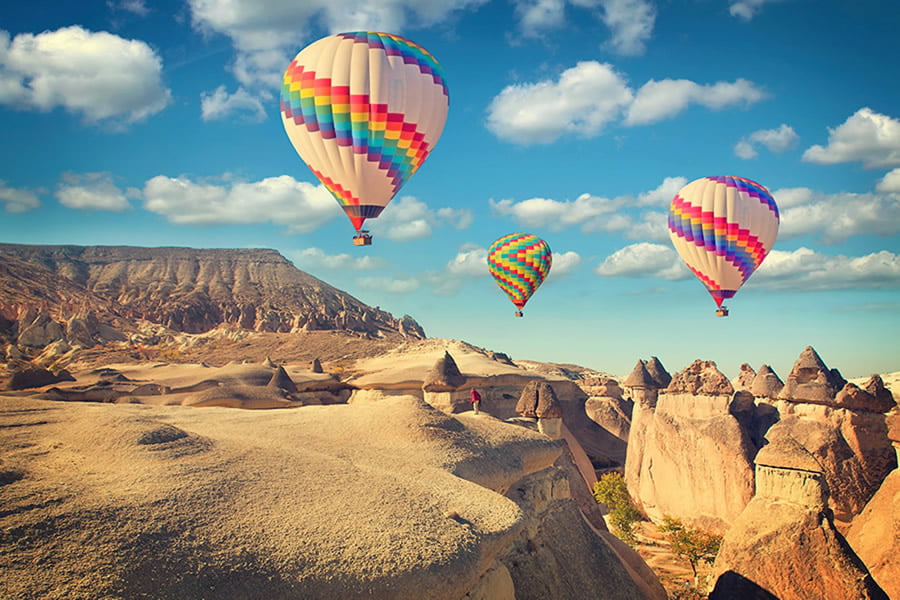
Cappadocia
Cappadocia was one of the earliest sanctuary for Christians, With its natural formations and so many historical remains of earlier civilizations, Cappadocia offers an open air museum to its visitors.
The region of Cappadocia is located in the middle of central Anatolia, where volcanic activities played an important role to shape it million years ago. Erciyes, Hasandağ and Golludag were active volcanoes. The prehistoric paintings suggest us this activity persisted into the Neolithic period.
Because of the volcanic eruptions being so strong, the lava in some places was up to 150m thick. Over many millions of years, volcanoes, wind, rain and ice sculpted this actual region known as Cappadocia. Upon the landscape’s eroding, basalt stones stayed strong and formed conical shapes called as “Fariy Chimneys”.
A unique world heritage for humanity
Cappadocia offers travellers a unique landscape and natural wonders beyond expectations and exceeding their imaginations. These wonders are done by human-hands with great workmanship. This wonderland consists of cities such as Aksaray, Nevşehir, Niğde, Kayseri and Kırşehir. In these cities, the land has been formed into unusal forms over millions of years.
Harmony of Civilizations
After researchers unearthing, Köşk Höyük, Aşıklı Höyük as well as the Civelek Cave have enlighted us more about the history. During the Middle Bronze Age, Cappadocia came under the influence of Assyrian civilization due to extensive trade.
In this period, writing was also introduced to people.. Researchers have found remains of “Cappadocian tablets” – clay tablets inscribed with cuneiform writing – whose texts speak of tax regulation, interest rates, marriage contracts, trade disputes and much else besides. The Hattis, Hittites, Phrygians, Persians, Romans, Byzantines, Seljuks and Ottomans were all enchanted by the allure of the region and left the imprints of their presence here.
Because of its location, Cappadocia has always been a critical and strategic region throughout the years. Important trading routes, including Silk Road, traversed the land of Cappadocia both east and west and north and south. As a result of this heavy traffic, it has been a complex web of historical and cultural influences. Cappadocia’s trade and resources were tempting, thus the region was frequently invaded, raided and looted.
Early Dwellers of Cappadocia
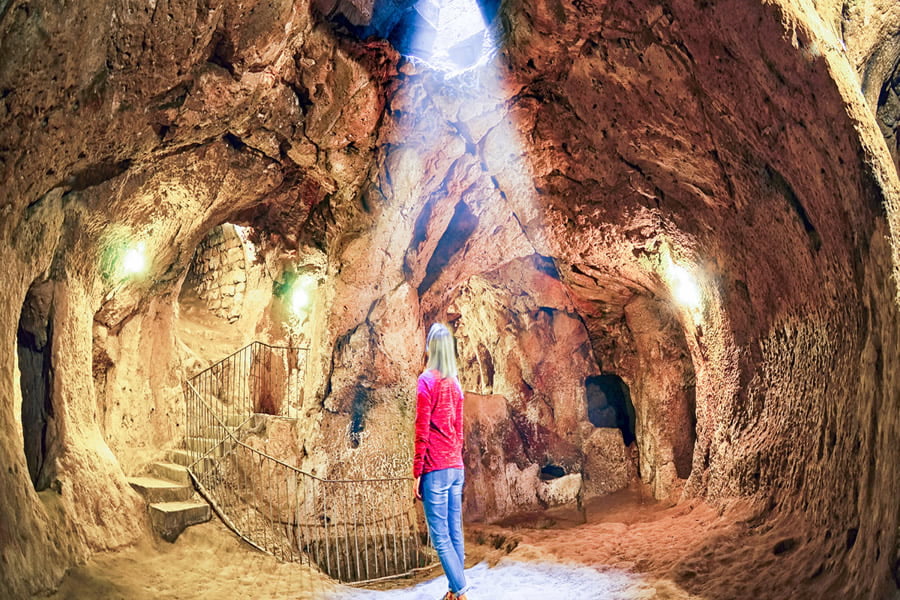
To protect themselves from such incursions, the locals took to living in the region’s caves. Early people concealed the enterances so as not to be noticed by trouble-making outsiders. Since it might be necessary to lie low for extended periods of time, these troglodytic dwellings eventually became subterranean cities that included sources of water, places to store food and had wineries and even temples. Some of these subterranean cities date back to pre-Christian era.
Sanctuary of Christians in Cappadocia
In the early years of the first millennium, groups of Christians fleeing Roman persecution began moving into the inaccessible wilds of Cappadocia seeking refuge. One group which arrived from Jerusalem via Antioch (Antakya) and Caesarea (Kayseri) in the 2nd century settled down in the area now known as Derinkuyu. Finding the soft volcanic tuff easy to carve, they began to expand the natural caves and link them together, creating dwellings, chapels, churches and monasteries. This way, these people found the peace and security.
Home of Churches
It is said that there are around 500 churches and chapels in all around the region. Moreover, The variety and artistry of their architecture, layout and decoration are fascinating and amazing. Basilicas with single, double or triple naves, cruciform plans, vestibules, aisles, apses, domes, columns, pillars in these churches that were hollowed out of stone. Many of the churches are also decorated with carefully-painted frescoes. The monumental task of restoring, repairing and maintaining these churches and underground cities goes on even while they receive thousands of visitors a year.
Modern Cappadocia
Tourists from all around the world have started coming to Cappadocia since 1980s to discover and experience lifestyle of early people since 1980s. To accomodate the needs of the visitors, locals have turned their houses into guest houses, cave hotels, restaurants and so. Especially after 1989, when the first hot air balloon ride took place, it’s started to become viral in many countries. Because Cappadocia is a large region with much to discover, locals also have started travel agencies providing high-end travel services such as, daily tours, airport transfers, tickets to other cities, rental companies and daily activities.

Latest News
Travel Plans for 2022 season
Greetings to all our fellow followers! Time to make your travel plans!
Apr


